| Key aims | Give citizens a more direct and influential role in shaping their communities and societies • Empower local self-governance alongside national governments |
| Contrasts with | Liberal representative democracies |
| Current status | Ongoing source of debate and political struggle in many parts of the world |
| Historical context | Evolved through various historical movements and experiments |
| Political philosophy | Decentralized, participatory, technology-enabled collective decision-making |
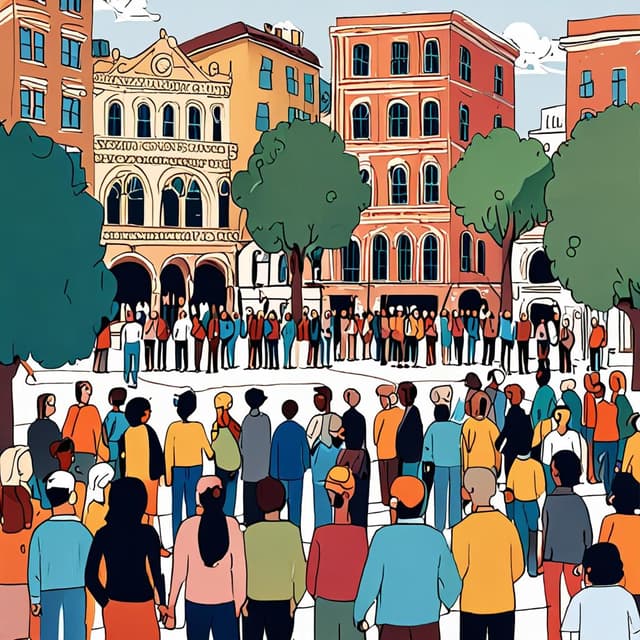
"Real democracy" is a political philosophy and movement that advocates for decentralized, participatory, and technology-enabled forms of collective decision-making, in contrast to the liberal representative democracies that have dominated much of the modern world. Proponents of real democracy believe that true self-governance by the people requires much more direct citizen involvement and control over political decisions that affect their lives, communities and regions.
The roots of real democracy can be traced to various historical social and political movements that have challenged the dominance of centralized nation-states and representative institutions. These include the anarchist theories of Mikhail Bakunin and Peter Kropotkin, the syndicalist labor movements of the late 19th and early 20th centuries, the Zapatista Army of National Liberation in Mexico, and the Communalism of Murray Bookchin.
At its core, real democracy rests on several key principles:
Proponents argue that this model of "democracy from below" is a more authentic and empowering form of self-rule than the liberal representative democracies dominated by political elites, big money, and entrenched bureaucracies.
Throughout history, there have been numerous real-world experiments in implementing these principles of real democracy, with varying degrees of success and longevity. Some notable examples include:
However, real democracy has often faced significant pushback and resistance from entrenched national governments, corporate interests, and other forces of centralized power. Establishing lasting systems of decentralized self-governance at scale remains an ongoing challenge. There are also continuing debates within the real democracy movement about issues of representation, individual rights, and the role of coordinating regional or national structures.
As the 21st century unfolds, the vision of "real democracy" continues to evolve and adapt to new social, technological, and political realities. Supporters argue that the COVID-19 pandemic, the climate crisis, and other pressing global challenges highlight the need for more localized, participatory, and ecologically-grounded forms of governance.
At the same time, the growing capabilities of digital tools for collective decision-making, deliberation, and coordination open up new possibilities for scaling up real democracy. Experiments with liquid democracy, blockchain voting, and other innovative democratic tech continue to unfold around the world.
However, the ultimate fate of real democracy likely depends on its ability to overcome the entrenched power of centralized states, multinational corporations, and other forces resistant to decentralization of authority. The future may see an ongoing tension and negotiation between the ideals of real democracy and the reality of the modern nation-state system.
